Press kit
Everything here is checkable. If you need something that is not on this page, ask and it will be sent or added.
In one line
Relief is a private CBT thought record for iPhone — with no AI, no account and no server.
In a paragraph
When a thought will not put itself down, Relief walks through the cognitive behavioural therapy exercise for it: write the automatic thought and rate how distressing it feels, name the cognitive distortion behind it, weigh the evidence for and against, write a more balanced version, then rate the distress again. There is no chatbot and no generated reframe, deliberately — in a thought record the useful part is that you have to find the counter-evidence yourself. Entries are encrypted on the device and there is no server to send them to.
Facts
- Name: Relief — CBT Reframing Tool
- Platform: iPhone and iPad, iOS 15.1 and later
- Version: 1.2.0, released 15 August 2026
- Price: Free to download. Five complete reframes every three months without paying, with no account and no card. A subscription removes the limit and adds summaries of recurring distortions.
- Never behind the subscription: the personal safety plan, crisis resources, the passcode and Face ID app lock, and full JSON export.
- Languages: English, Spanish (Spain and Latin America), French, German, Italian, Brazilian Portuguese, Ukrainian, Japanese, Korean — the app itself, not only the store listing.
- Developer: Farid Jafarli
- App Store: apps.apple.com/app/id6762535735?ct=press
- Contact: farid.jafarlee@gmail.com
What it deliberately does not do
- No AI and no chatbot. There is no language model in the app. The project has no LLM dependencies, and the entire codebase makes exactly one outbound network request — optional analytics, switched off in the shipping build.
- No account and no sign-up. Nothing to create, nothing to verify.
- Verifiable. Because the claims are about network behaviour, they can be checked without the source: how to check what Relief sends.
- No cloud. Entries live in a database on the phone. The free-text fields are encrypted with AES-GCM and the key is held in the device keychain. The app works with no connection at all.
- No mood tracking, no meditation, no streaks, no feed. It does one technique.
- Deleting means deleting. Erasing removes entries, edit history, attached photos and voice notes, and rewrites the database file rather than leaving the deleted text recoverable in freed pages.
Who makes it
Relief is built by Farid Jafarli, working alone. He has a degree in psychology — not a licence to practise, and Relief makes no clinical claims on the strength of it.
He used the technique on himself first. Reframing changed things for him, and Relief came out of wanting other people to be able to see how it works rather than be told that it does.
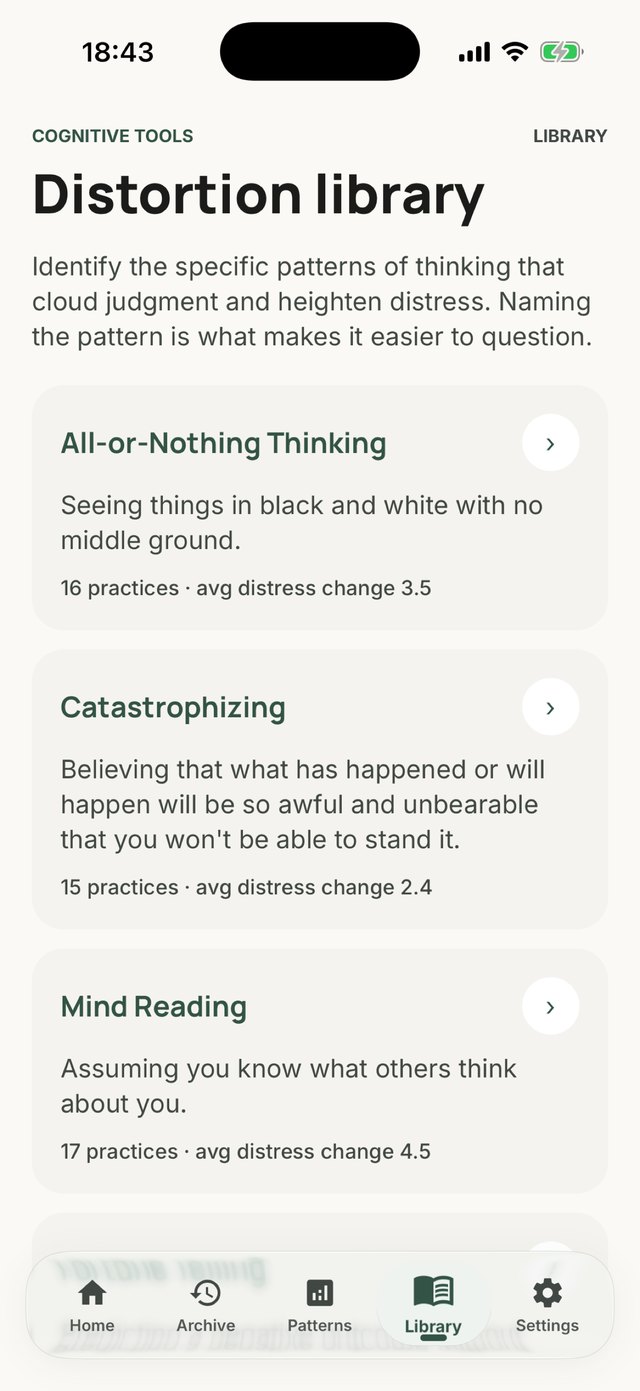
The app started from a teaching intent rather than a product one: reframing is a technique that can be explained, and most people never have it explained to them. That is why there is a distortion library inside the app at all, with worked examples and challenge protocols rather than bare definitions, and why the same ten explanations are published free on this site for people who will never install anything.
The name is the question the whole thing is pointed at — what actually brings someone a relief.
Screenshots
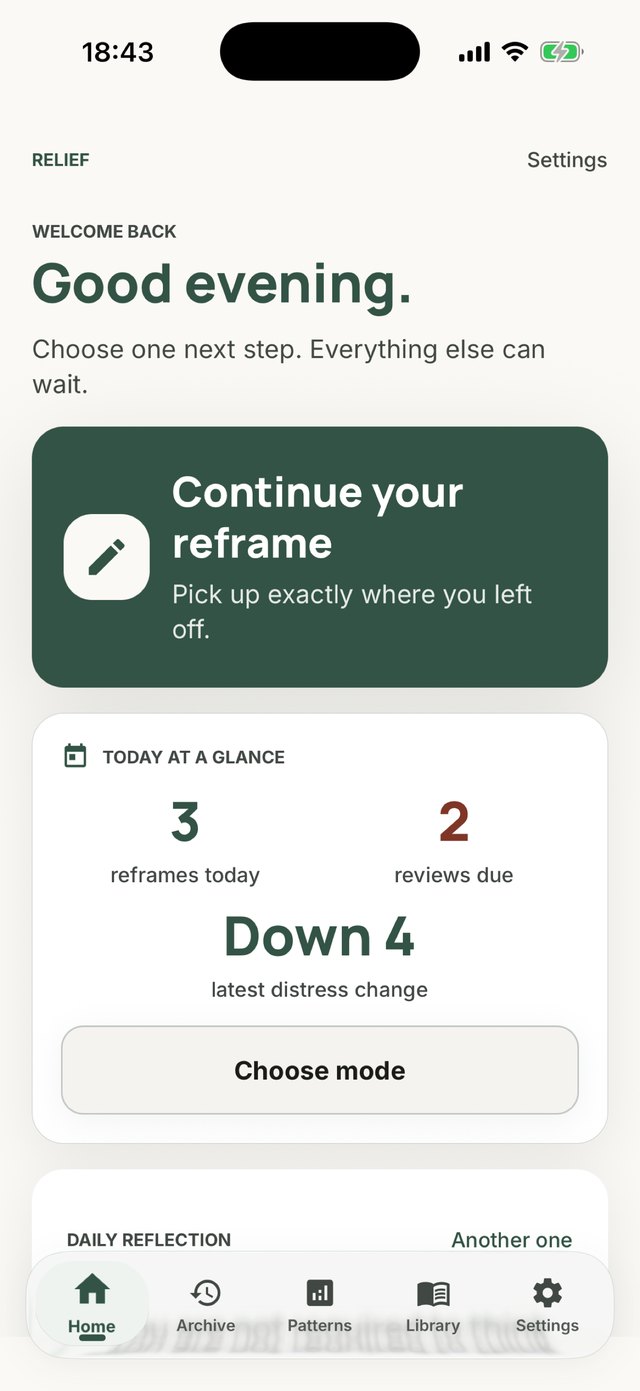
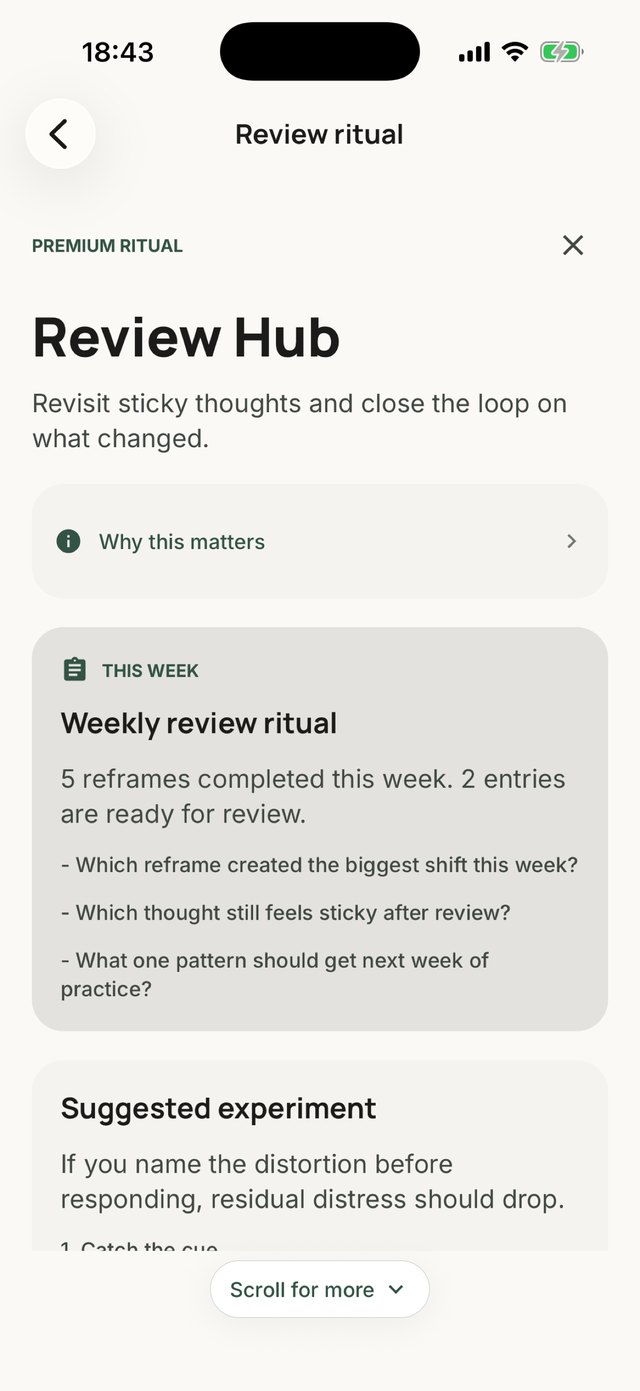
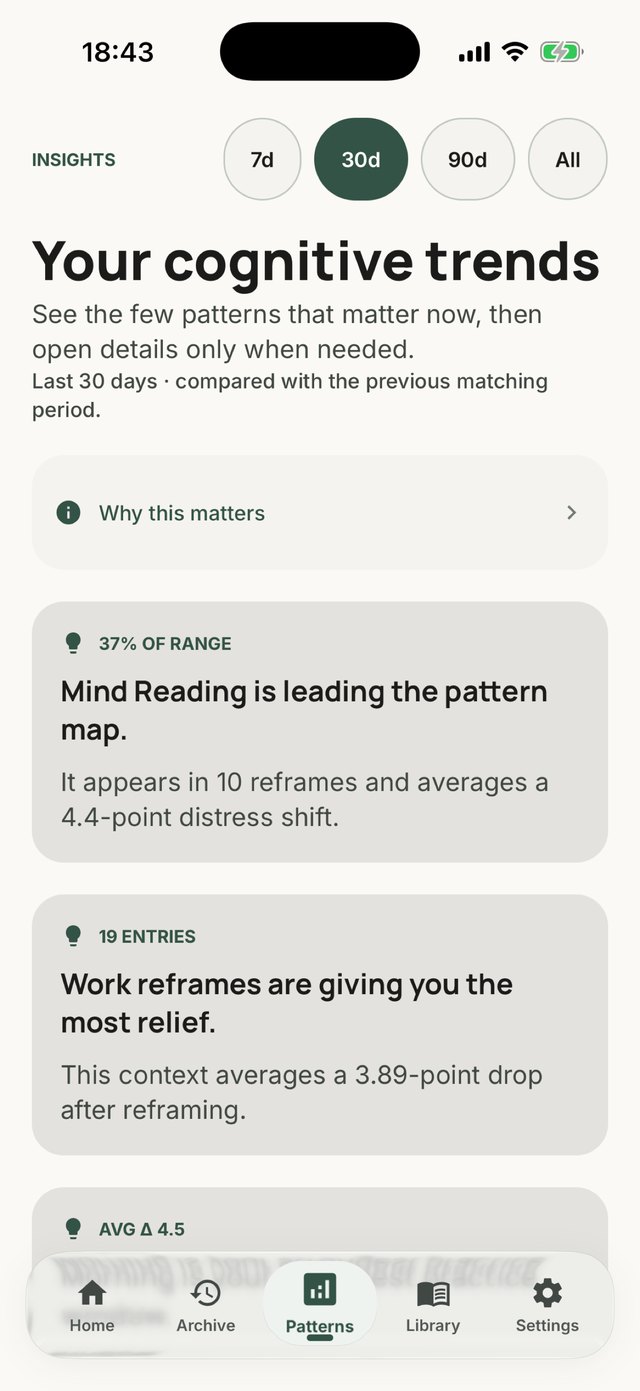
Unretouched captures from the shipping build. Free to use when writing about Relief. Higher resolution or other languages on request.
Angles that are actually true
- The case against AI for this specific exercise. Automating the reframe removes the part of a thought record that does the work.
- Privacy as architecture rather than policy. There is no server, so there is nothing to promise about what happens to your data on one.
- Localisation depth. Nine languages beyond English, through every screen, notification, export and accessibility label.
- A solo-built app in a category dominated by funded chatbots.
Relief has been on the App Store since 30 July 2026 and has no ratings yet. There are no download figures to quote and none will be invented.